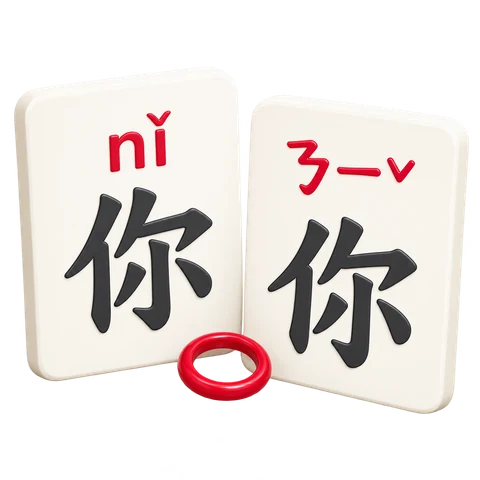

Numbered Pinyin is convenient to type, but marked Pinyin is useful in a reading list or lesson. We will convert a short list, inspect two easy-to-misplace marks, then reverse it. The interesting part is the last syllable: a neutral-tone number does not survive as a visible mark.
Start with a short numbered list
Open the Pinyin tone converter. Set Convert to to Tone marks · nǐ hǎo. Paste ni3 hao3, liu2, gui4, Xi1'an1, ma5 into Your Pinyin. The output updates as you type; Convert also runs the conversion.
Read Converted Pinyin: the verified result is nǐ hǎo, liú, guì, Xī'ān, ma. The capital X, commas, spaces and apostrophe remain in place. This is a spelling list, not a Chinese sentence. The converter changes the notation you supplied; it does not translate words or decide what they mean.
Start with one line when working from unfamiliar material. A short test makes an omitted number easier to spot before you convert a longer worksheet. The page accepts up to 10,000 characters at a time.
Check placement and syllable boundaries
Notice liu2 → liú and gui4 → guì. For iu and ui, the mark belongs on the second vowel. This placement follows the Hong Kong Polytechnic University’s Pinyin spelling reference.
In Xi1'an1, the apostrophe visibly separates the vowel-initial second syllable. Keep such boundaries in your notes. Numbered syllables make their endings explicit, but a joined marked spelling can be ambiguous when reversed. Add spaces if the tool leaves a word unchanged.
Invalid text is not silently repaired. In our test, not6 stayed unchanged and produced a spelling warning. Read the message below the controls and correct the input rather than assuming every letter group became valid Pinyin.
Review Pinyin tones for mark placement. Use the Pinyin sound chart when the spelling itself is unfamiliar.
Reverse it without inventing a neutral tone
Choose Reverse direction. The result becomes the new input and the direction changes to tone numbers. Our example returns ni3 hao3, liu2, gui4, Xi1'an1, ma. The last syllable remains ma, not ma5.
Both ma5 and ma0 become unmarked ma when converted to marks. The text no longer says which neutral-tone number you originally used. An unmarked syllable could also have an accidentally omitted tone, so the default leaves it alone.
Because we know this example ends with a neutral syllable, enable Treat separate unmarked syllables as neutral. With Neutral tone number set to 5 · ma5, the ending becomes ma5. Choose 0 · ma0 to obtain ma0 instead. Use that option only after checking the unmarked syllables in your input.
Copy the result into a useful study task
Choose Copy result and paste into your notes. Keep the Chinese word beside its reading when you know it; one pronunciation can correspond to more than one word. There is no separate file-export button on this converter.
To find readings from characters, continue with Chinese to Pinyin. To produce Chinese text from a reading, open the Pinyin keyboard and choose a candidate. A correct tone conversion does not certify a character choice.
The converter works within the page without dictionary downloads or a conversion server. Keep a copy of important notes: the tool does not save a study document for you.
Common questions
Does it choose the correct tone for a word?
No. It uses the numbers or marks you supply. If you do not know a reading, look it up first and review it in context.
Can I use v or u: for ü?
Yes. For character entry and its different input rules, see how to type ü in Pinyin.
Does ni3 hao3 become ní hǎo?
No. It becomes nǐ hǎo, preserving the two tones supplied. Spoken tone changes are a separate pronunciation topic.
Why did a marked word stay unchanged?
Check its spelling and mark placement, then separate the syllables. The tool reports ambiguous or invalid spellings rather than guessing.
Give your notes clear tone marks.
Try the short list, inspect it, then copy the notation you need.