
Cangjie root names are useful memory labels, but a character often contains a narrow related form rather than an exact copy of that name. Compare 沐 and 休. Both contain 木 on the right. Their different left parts explain why the full codes are ED and OD. This small contrast is a practical starting point for learning decomposition.
Connect three root names with their letter keys
Open the Cangjie root chart. Find 木 D, 水 E, and 人 O. Read each root name together with its letter. The letter is what you type; the root character helps you remember the shape family.
Search for 沐 and open the matching card. Its note explains that 氵 belongs to E and 木 uses D. Close the detail view and find 休: its narrow person-side form 亻 belongs to O.
Do not replace O with the number zero. Cangjie uses letter keys for these codes. If your device’s system input method is converting the letters before they reach the page, switch that device input to ordinary English letters.
Read the two examples from left to right
Open Cangjie decomposition. The 沐 example shows 氵 + 木, with E + D underneath. The 休 example shows 亻 + 木, with O + D. Keep each part intact and read its contribution in order.
The common right-hand 木 makes the contrast easy to see. You change the first key when the left component changes, then keep D for the shared component. This is a study comparison between two characters, not a claim that the adjacent characters form a word.
These diagrams show code parts. They are not stroke-order animations, and you do not type one key for every pen stroke. Related forms can look different from their root names while belonging to the same key family.
Once those two feel familiar, compare 好 VND. Its left 女 contributes V, while 子 contributes two keys, ND. A visible part does not always correspond to exactly one letter.
Type the full codes and inspect the results
Open the Cangjie keyboard. Enter ed in Input code. Find 沐 in the candidates and click it. If it is not in the visible five choices, use the candidate arrows or Page Down.
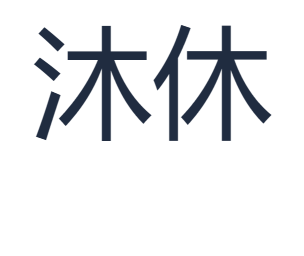
Next enter od, find 休, and select it. The verified editor result is 沐休, two study characters side by side. In this check, 沐 appeared on the third candidate page and 休 on the second.
Short full codes can share a lookup with Quick aliases. A correct two-letter code therefore need not put its character first. Check the displayed character instead of pressing Space automatically or memorizing a candidate position.
The image above is the actual Save image download, using Arial at size 120 for clarity. You can use Copy text for editable characters; an exported PNG is only their visual appearance.
Turn the contrast into a repeatable study routine
Cover the keys in your notes and look at 沐 and 休. Recall the left part first, then the shared 木. Say the letters to yourself, type the code, and check the candidate. If the left-side key is uncertain, revisit that root card rather than guessing the whole sequence.
The chart’s Show keys checkbox can hide the letter labels for recall. Print reference prints the current selection, so clear a search or filter first when you want the complete chart.
Use Cangjie practice for selected checked full-code exercises. For a new character outside the set, code lookup supplies available dictionary codes, while code breakdown helps read a sequence you already have.
Common questions
Are roots the same as dictionary radicals?
They serve different jobs. This chart teaches keys and shape families for input codes. Do not assume a dictionary indexing radical alone supplies the complete Cangjie code.
Should I memorize all the keys immediately?
Start with a small group and examples that reuse it. D, E and O already explain the contrast here. Add other roots as you meet useful characters rather than copying the entire chart without testing recall.
What do X and Z mean?
The chart presents 24 basic roots plus special X for designated difficult forms. X is not a wildcard for an unknown part. Z is not one of the basic roots taught in this reference.
Will another Cangjie keyboard show the same order?
Not necessarily. This site mixes dictionary sources and compatibility entries. Code variants, character forms, and candidate ranking can differ across systems. Check the actual character on the keyboard you use.
Keep one part fixed. Notice the other.
Compare ED and OD, then find a third character that reuses a familiar root.